This is default featured slide 1 title

Go to Blogger edit html and find these sentences.Now replace these sentences with your own descriptions.This theme is Bloggerized by Lasantha Bandara - Premiumbloggertemplates.com.

This is default featured slide 2 title

Go to Blogger edit html and find these sentences.Now replace these sentences with your own descriptions.This theme is Bloggerized by Lasantha Bandara - Premiumbloggertemplates.com.

This is default featured slide 3 title

Go to Blogger edit html and find these sentences.Now replace these sentences with your own descriptions.This theme is Bloggerized by Lasantha Bandara - Premiumbloggertemplates.com.

This is default featured slide 4 title

Go to Blogger edit html and find these sentences.Now replace these sentences with your own descriptions.This theme is Bloggerized by Lasantha Bandara - Premiumbloggertemplates.com.

This is default featured slide 5 title

Go to Blogger edit html and find these sentences.Now replace these sentences with your own descriptions.This theme is Bloggerized by Lasantha Bandara - Premiumbloggertemplates.com.

Mostrando las entradas con la etiqueta Pecs. Mostrar todas las entradas

sábado, 15 de octubre de 2016

TOP 5 CHEST-TRAINING MISTAKES


#1 Overreliance on barbell bench presses

“How much can you bench?” The question is asked so often of anyone with a modicum of muscle that it’s long been the ultimate gym cliche. Still, the fact that the bench press is the go-to strength barometer has had a decimating effect on chests. Bodybuilders bench too much too often for too many sets of too few reps. Used correctly, the bench press is an excellent exercise. Overused, it can potentially overdevelop the lower-pec region in relation to the upper region, giving you “droopy boobs” (think Art Atwood). Furthermore, consistently benching for maximum sets of low reps will boost your chances of injuries, ranging from shoulder, elbow and wrist strains to pec tears.

Solutions:

  • Think of barbell bench presses as just another chest exercise, one that can be done at any time during your routine, including last.
  • Do sets of eight to 12 reps, only occasionally pyramiding to as low as six reps.
  • If you’re curious about how much you can bench for a single rep, use an online calculator and your best 10-rep set to compute your one-rep max.
  • If you always do barbell benches first, start with incline presses–with barbells one workout and dumbbells the next. Alternately, cycle eight-week periods during which you do no free-weight benches with eight weeks during which you do benches with barbells one workout and dumbbells the next.


#2 Under training upper chest

Often occurring in concert with an overreliance on bench presses is an underreliance on exercises that target the upper-pec region. This is the area from your clavicles to approximately halfway down your chest. It gives your torso a higher appearance and visually ties your pecs in with your delts and traps (think Franco Columbu). Pecs are naturally thinner at the top than the bottom, so everyone can prioritize their upper pecs via incline work without fearing that this region will overpower their lower pecs.

Solutions:

  • Do incline presses with a barbell or dumbbells first in your routine.
  • In each chest workout, include at least as many sets of upper-chest work (incline presses and flyes) as you do lower chest work (flat and decline presses and flyes, and dips).
  • To focus cable crossovers on your upper chest, perform them with the cables set near the floor, so that you are pulling the handles up and together on each rep.
  • Practice posing your upper pecs with hands-on-hips most-musculars or simply tensing. This will build a greater mind-muscle connection, so you can feel this area contracting on targeted chest exercises.

#3 Overreliance on machines

While too many bodybuilders do too many sets of benches, there is another group that goes to the other extreme–they rarely grab barbells or dumbbells on chest day. Most modern gyms have a plethora of press and flye machines, but resist the urge to form the bulk of your routine around mechanical movements. Despite modern advantages, the best chests of Arnold’s era still compare favorably with the pecs in recent Olympia pose-downs. Why? Then, pecs were worked almost exclusively with free weights.

Solutions:

  • Do mostly free-weight and body-weight basics.
  • Do no more than half of your chest exercises with machines.
  • If you do mechanical presses, try to choose a unilateral Hammer Strength, FreeMotion or similar machine that approximates the freedom of free weights.
  • If you’re not strong enough to get eight bodyweight reps while dipping, use a dip assist machine to lighten your load. (This doesn’t count as a machine exercise.)

#4 Failure to contract

The downside of free weights is that they make it difficult to attain a maximum contraction in the pecs. When you do dumbbell flyes, there is less resistance on the chest at the top of the movement (when the dumbbells come together) than near the bottom. Likewise, during presses or dips, the triceps do much of the work near lockout.

Solutions:

  • Do one flye exercise each workout with either a machine or training bands. If you do cable crossovers, cross one hand over the other (hence the name) at contractions. Similarly, if you use an upright flye or pecdeck machine, or do flyes with bands, perform repetitions unilaterally in order to bring your hand past the center plane of your body to lengthen contractions.
  • Lock out on presses. Although your triceps will do much of the work at the end, you can still maximally flex your chest at contractions.


#5 Working the weight, not the muscles

“Work the muscles, not the weight” is one of Jay Cutler’s favorite aphorisms. Working the weight is different than focusing too much on the number of pounds used, and thus going too heavy. ''Working the weight is using speed and momentum to pound out reps with little or no regard for the targeted area and it’s a precise distillation of the way many bodybuilders press, flye and dip.''

Solutions:

  • Feel where you want to focus each set before it begins. For example, tense your upper chest before a set of incline presses to keep your attention on that area.
  • Always utilize strict form. This is not only safer, but also better for targeting your pecs, because the sloppier your execution on a chest exercise is, the more that secondary muscles take over.
  • Carefully control the negative halves of reps. During presses, take approximately two seconds to lower the weight and one to two seconds to raise it.

Lessons Learned:

  • Treat bench presses as just another chest exercise with reps in the eight to 12 range.
  • Prioritize your upper chest.
  • Do primarily free-weight presses and flyes.
  • Concentrate on the contraction of each rep.
  • Keep the focus on your pecs, not on the weight.

AUTHOR: Greg Merritt

jueves, 12 de noviembre de 2015

CHEST EXERCISES FOR BUILDING MUSCLE

CHEST:

It is well know that the chest is one of the most sought after well developed body parts for men along with arms and abdominals, however it is quite beneficial for women as well. It is a misconception that chest training reduces bust size for women. Finally, even though genetics spell out the shape and size of your pectoral muscles, as with all of your muscle groups, your training discipline can help you reach your physique goals.

ANATOMY AND BENEFITS:

The chest is combination of the pectoralis major and minor. The first flexes and adducts the arm, medially rotates the arm, the latter draws the scapula forward, medialward, and downward. For the purpose of discussion, we'll separate the chest into four basic regions; upper, lower, outer and inner.

EXERCISE BASICS:

The chest is a muscle which must be trained for all of its areas to develop completely. Usually for males, a full and wide chest is the goal. It is very important as with most large muscle groups to build a foundation of the muscle before concerning yourself with details. This foundation phase will be the building blocks to further detailed work. With the pectoral muscles, it is significant to follow a plan which will consist of a few basic movements along with some isolation movements. Proper form, contraction and stretching will boost your gains and help prevent injuries. There is a wide range of exercise to properly stimulate all areas of the chest muscles for men and women.

OPEN THE NAME OF EACH EXERCISE

CHEST EXERCISES

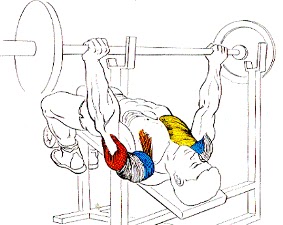
Barbell Bench Press
Incline Bench Press
Decline Bench Press
Wide Grip Bench Press
Wide Reverse Grip Bench Press
Guillotine Press
Barbell PullOver
Dumbbell Flys
Push Up
Dumbbell Bench Press
Incline Dumbbell Bench Press
Decline Dumbbell Bench Press
Cable Chest Press
Cable Lower Chest Raise
Chest Dip
Pec Deck
Incline Dumbbell Flys
Bench PushUps

domingo, 6 de septiembre de 2015

5 BRUTAL CHEST WORKOUT

You’re spent after a brutal chest workout, but you still want to take it to the next level. You’ve got it in you to squeeze out those last few untouched muscle fibers – you know the ones – those that will take your chest development to new heights and finally unlock your real potential.
If you’ve crossed all of your T’s and dotted all of your I’s then it’s time to put a big, bad exclamation point on the end of an already awesome workout. These 5 chest finishers will do just that; crush your chest so it will have only one thing to do: to grow back bigger and better. Demand more, here’s how.

1. 3-WAY PUSH-UP


One of the simplest, but most effective ways to finish off your chest for good is to do something we were meant to do with little-to-no equipment – the push-up. But here’s the catch: you will do a triset (3 sets back-to-back) at different angles. The difficulty will regress as the continued stress will progress.
Here’s how: Assume the elevated push-up position (feet on a bench). Perform as many reps as you can with textbook form. Once you are too fatigued for another full rep, put your feet on the ground and perform additional reps until muscular failure. Once you are completely spent from that position, place your hands on a bench and grind out your last set. That is one set. Shoot for at least 3 trisets always perfecting your form. It will be easy to get loose during these trisets but fight the urge and press on!

2. MACHINE GUN PRESS 100


Barbells, dumbbells and bodyweight moves should comprise most of your chest training but nearing the end of an intense workout your supportive muscles will suffer. Balance and coordination will be compromised and your ability to perform certain moves safely will suffer. Machines work well when it comes to finishing off a body part, namely chest. Helping with balance and focus, machine presses can be done to give your chest that one last blast of fatigue.
Here’s how: Using a Hammer Strength machine, or any other type of machine press station set the weight at a very light and manageable number. Start by shooting for at least 40 reps (ideally 50). Once you have reached total fatigue it will be your partners turn. Keep switching off with no rest between sets until you both have reached 100 total reps. No matter how many reps you manage to get each set keep this back-and-forth “machine gun” style going. One set will consider you done!

3. CABLE CROSS COMPLEX


Cable crossovers have always been thought of as a small finishing exercise done at the end of a workout to round out the pecs. Normally set at a high level, they are done in normal, straight set fashion. Let’s change that. Let’s do something that will pulverize your pecs into new growth and really find out what you are made of.
Here’s how: Set the cable pulleys at the lowest position and perform low cable crossovers arching the handles up to face level. Once fatigued, raise the pulleys to chest level and continue your set. Again, once you can’t perform another full rep raise the pulleys one last time to the top position and finish your crossovers set. Once finished there immediately drop to the floor and do as many reps of push-ups as possible. That is one set. Shoot for 3.

4. 3-ANGLED ATTACK


Sometimes a crowded gym is your worst enemy. Little availability of the equipment you need and not much room to move. Luckily this finisher only requires a bench, a barbell and a pair of dumbbells all in one spot. Here you will utilize a multi-angle attack to fry every area of your pecs from the top to the bottom into submission without moving an inch.
Here's how: Start with a reverse grip bench press (dumbbells may also be used if you don’t have access to a bench press station). Performing reps with a reverse grip will target the upper pecs. Next, either pick up a pair of dumbbells or use the same barbell and perform traditional flat bench presses with an overhand grip. Lastly, place your feet on the bench and put your body in a bridge position with your upper back still on the bench. Your body should be angled in a straight line. Perform“decline” chest flys with dumbbells to finish off. Do 3 total trisets.

5. PUSH-UP STRIP


Ah yes, back to the push-up. So simple yet so effective. The push-up represents real world strength. Practical, efficient and no equipment required they truly are a true measure of full body control and ability. However, this time you will need a partner to help load weight for the ultimate strip set. Here you will take one of the greatest moves of all time and make it harder.
Here’s how: Assume the traditional push-up position. Have your partner place several weight plates on your upper back. The more number of plates the better for the sake of stripping off the weight. Your partner may need to steady the plates while you perform your reps so have him/her close by. Perform your reps slowly and under complete control. Once you reach fatigue have your partner remove a plate each time and keep going. Do this sequence until you are left with just your bodyweight and repping out until total muscular failure. Do 3 total sets. 

lunes, 29 de junio de 2015

THE TOP 5 EXERCISES FOR CHEST

The Anatomy of the Chest

Understanding the function of the chest muscles is a vital step before throwing yourself into a vigorous routine. In the body, no muscle group is an island, and a basic knowledge of how the groups function together will help prevent you from causing injury, while simultaneously informing you of how and why the workout works. This knowledge will help you concentrate on posture, form, and performance.

The chest is made up of two muscles the Pectoralis major, and the Pectoralis minor.

Pectoralis Major: Is the large fan shaped muscle that is located on the front of the chest. It originates from both the sternum (breast bone) and the clavicle and inserts into the humerus. This muscle is responsible for flexing and extending the humerus, as well as adducting and medially rotating.

Pectoralis Minor: Lies under the pectoralis major, and is a much smaller triangular shaped muscle that stabilizes the action of the scapula.

The Top 5 Exercises for Increasing the Chest

Top Chest Exercise #1 – The Barbell Bench Press


The undisputed king of chest expansion for hundreds of years, the bench press has been the standard for increasing strength and size in the chest by experts around the globe. It is possible to perform the bench press in a few variations, but for the purposes of this article, we will start by discussing the wide grip, pec pounding bench press.

Lie flat on your back on a standard Olympic weight bench. With your feet flat on the floor and your glutes tight to the bench, back and head on the bench at all times, unrack the bar from the bench and lower it to your chest. Pressing your feet into the floor while maintaining a flat position on the bench, use both arms to drive the bar straight up.


Top Chest Exercise #2 – Explosive Push-ups


The standard bench press will only get a person so far when trying to attain more muscle mass in the chest. To supplement normal weightlifting, it is important to incorporate more rapid motions into any chest program. This is difficult to do safely with weights, so smart bodybuilders turn over and put their nose to the floor for some push-ups that will create the most powerful resistance through explosive movements.

To begin, get down on your hands and knees. Extend your feet back and hold your position with your toes. Place both hands approximately shoulder width apart, and begin by flexing your arms so that your chest lowers to the floor. With as much power as you can muster, push against the floor hard enough to pop your hands off of the ground. You can increase the challenge by trying to jump your hands up to elevated boxes, or by clapping between each jump.


Top Chest Exercise #3 – Inclined Bench Press


This top chest exercise is extremely similar to the standard bench press listed above in that it works the same primary muscle groups (pectorals, deltoids and triceps.) The incline of the bench press however places a great deal more of the workload onto the upper chest.
To perform, use a press bench that can be raised to an incline position. Unrack the weight and lower the barbell until it touches your upper chest. Press the weight back up into the starting position with arms fully extended and repeat. Keep your elbows tucked in to maintain a 45 degree angle to your flanks. If you allow your arms/elbows to deviate outward you’ll be placing excessive strain on your shoulder joints.


Top Chest Exercise #4 – Decline Bench Press


Again, another workout that is very similar to the standard bench press. It works the same muscle groups (pectorals, deltoids and triceps). The decline of the bench press however puts a great deal of emphasis on the lower chest muscles.

To perform, use a press bench that is adjustable and move the seat into a decline. Unrack the weight and lower the barbell until it touches your lower chest, upper abdominal region. Once again, you’ll need to keep your elbows turned in to your body so that your arms are at a 45 degree angle to your flanks. If you allow your elbows to drift outward you’ll be placing excessive stress on the shoulder joints.


Top Chest Exercise #5 – Forward-Leaning Dip


The dip is no joke. It's a tough compound exercise that makes great use of your bodyweight. However, dips are usually performed in an upright position to target the triceps. By simply adding a forward lean to this already-effective exercise, you'll stimulate more chest activity.

You can attempt to do this on your own, but if you really want to get the proper angle you'll need a training partner to help you get into the right position. You can easily make it more challenging by adding weight via chains or a belt.

A word of caution for people with any shoulder issues: Start with a small range of motion and listen to your body to determine how deep you can go. I always advise getting a full range of motion, but not at the risk of injury.

EXECUTION:


1. Place your hands on the bars and push yourself up until your elbows are locked. Cross your legs back with your knees bent, core tight, and hamstrings and glutes braced. 

2. Have your training partner hold and pull your legs back until you're in a forward leaning position, using just enough assistance to get you into the right angle. Your body should be at approximately a 30-degree angle to the ground. 

3. Lower yourself until your shoulders are lower than your elbows, or you feel a good stretch across the chest. Listen to your body and don't push through shoulder pain. 

4. Push yourself up by extending your elbows to 180 degrees for a full range of motion. Visualize the pec squeeze as you drive up.


The important thing is to integrate these exercises into your daily routine among other programs. You do not want to have a series of “target chest muscle” days. Combine individual workouts with your other muscle group routines to get the optimal increase in mass for your chest. Increasing the size of your chest takes significant effort and a lot of time. While it’s ok to occasionally put some training on hold to target individual muscle groups, don’t let the other areas of your body fall to the wayside while concentrating on your chest. Now go hit those weights hard.

viernes, 5 de junio de 2015

HOW TO TRAIN YOUR CHEST/PECS FOR MAXIMUM GROWTH


The key to training each of your muscles is to understand their function and how they work. Your chest is no different. Here, we’ll go over your pectoral muscles, how to train them, and we’ll even dispel a few myths along the way.


Chest Anatomy:

The pectorals are your chest muscles. They begin at your sternum and connect to a tendon that attaches to the humeris bone in your upper arm. Each time your chest muscles contract, they essentially pull your upper arm bone forward and in front of you.

To get a feel for the full range of motion of your chest muscles, straighten your arms out to each side of you. Move your arms forward in front of you until your forearms cross. This represents the full and complete range of motion for your chest muscles.

We’ll just skip the rest of the anatomy lesson and get to what you really need to know. For your training, your pecs are essentially trained as a whole using exercises like the bench press, or you can use exercises that focus on your upper chest such as the incline bench press.

Aside from the upper chest exercises, there isn’t really as much specialization for the chest as one might think. Let’s take a look at the different chest specialization areas you might have heard of.
General Pecs: You will train your chest muscle group as a whole using the flat level bench. This includes the flat bench press, flat bench flyes, dumbbell bench press, etc. Dips will also train your pecs with somewhat less emphasis on the upper chest.


-Upper Chest: You train the upper portion of your chest using an incline bench. Exercises such as the incline bench press, incline flyes, and incline dumbbell bench press will all emphasize the upper chest.

-Lower Chest: The lower chest muscle is a myth. It’s simply not there. The decline bench press will work your chest from a different angle, yes. But there is no such thing as a lower chest muscle that is distinct or separate from other chest muscles.

-Inner/ Outer Chest Muscles: Again, there’s no such thing as focusing on your inner or outer chest muscles. Many people believe that flat bench flyes will work your outer chest while the peck deck flyes work your inner chest. This is more of an illusion that comes from the fact that each exercise places greater stress on your chest at different points in the range of motion.

The whole idea of working the inner/outer chest is flawed because it assumes that you can flex one end of a strand of muscle and not the other end. When you muscles contract, the whole entire muscle contracts, not just one end or the other. You cannot contract the bottom of your bicep without the entire bicep muscle getting shorter. It’s just not possible.


There are generally two main types of movements that work your chest muscles:

Pressing Movements: These include the bench press, incline bench press, and all of their variations and different angles. Dips are also included in the category. Pressing movements tend to directly involve the pecs, triceps, and deltoids in the movement. Secondary stabilizer muscles include your lats, posterior delts, and other back muscles.

Leverage Movements: This means chest flyes. Flyes can be done using dumbbells on a flat bench, using a peck deck machine, or using the crossover cables. Flyes are an isolation exercise. Do your pressing movements first in your workout, and add in flyes only when you’ve progressed to the point where you’re ready for more.

A training program that uses a flat bench pressing movement, an incline movement, and some dips will fulfill your chest training needs for quite a while. Stick to these basic movements before you get too carried away doing cable crossovers or other flye movements.
And of course, I know I probably don’t need to keep saying this to you, but don’t get too carried away with working only your chest and your arms. If you want to be a bodybuilder, train your whole body. Don’t be a boobie-builder.

Focusing only on your chest and arms is bad for your body’s balance and posture. Paying attention to building a strong back will balance you out and even give you greater stabilizing muscles that will increase your bench press and strengthen your pecs even more.