This is default featured slide 1 title

Go to Blogger edit html and find these sentences.Now replace these sentences with your own descriptions.This theme is Bloggerized by Lasantha Bandara - Premiumbloggertemplates.com.

This is default featured slide 2 title

Go to Blogger edit html and find these sentences.Now replace these sentences with your own descriptions.This theme is Bloggerized by Lasantha Bandara - Premiumbloggertemplates.com.

This is default featured slide 3 title

Go to Blogger edit html and find these sentences.Now replace these sentences with your own descriptions.This theme is Bloggerized by Lasantha Bandara - Premiumbloggertemplates.com.

This is default featured slide 4 title

Go to Blogger edit html and find these sentences.Now replace these sentences with your own descriptions.This theme is Bloggerized by Lasantha Bandara - Premiumbloggertemplates.com.

This is default featured slide 5 title

Go to Blogger edit html and find these sentences.Now replace these sentences with your own descriptions.This theme is Bloggerized by Lasantha Bandara - Premiumbloggertemplates.com.

Mostrando las entradas con la etiqueta Shoulder. Mostrar todas las entradas

domingo, 4 de diciembre de 2016

TOP 5 SHOULDER TRAINING MISTAKES

#1: Overemphasising Front Delts

All delt heads do not work equally, and the one that typically carries the heaviest load is the anterior. Your front delts are not only primary movers during overhead presses, they’re also secondary movers during chest and triceps workouts, helping during presses and dips. If you’re doing front raises in addition to a lot of shoulder, chest and tri compound lifts, you’re likely overworking your front delts.

"This is especially true if you train chest and shoulders in the same workout or on consecutive days."

Solutions:
  • If you hit chest before shoulders in the same workout, consider how much pressing and dipping you’ve already done before working delts. If the total is at least eight sets, do no more than four sets total of shoulder presses and front raises.
  • Don’t train chest and shoulders on consecutive days. Ideally, three days should pass between hitting each, so if you do chest on Monday, do delts on Thursday.
  • Dumbbell presses or presses behind the neck stress the middle delts more and front delts less, so these are good alternatives to military presses if you believe that your front delts are overtrained or that they’re outgrowing the other heads.
  • One cardinal rule of bodybuilding is that you can never be too wide. And so, it’s generally best to emphasize your middle delts more and front delts less on shoulder day, because the middles (most responsible for shoulder width) get little stress during other workouts and your fronts may assist during both your chest and tri sessions.
#2: Underemphasising Rear Delts

Just as anterior delts tend to get too much emphasis, posterior delts tend to get too little. Rear delts assist during lat exercises, such as rows and pulldowns; but if you’re targeting your lats correctly, it’s unlikely that your rear delts are receiving enough work on back or shoulder day to reach their full potential.

"Most bodybuilders relegate rear laterals to last place in their shoulder routines, and then go through the paces for four sets of minimal intensity. It’s no wonder posterior delts are so frequently your shoulders’ weakest links."

Solutions:
  • Consider training rear delts on back day, when you can emphasize them separately from their front and middle brothers. Perform four to six sets of rear laterals at the end of your back workout.
  • If you choose to train posteriors on shoulder day, don’t always perform them last in your routine.
"Instead, do rear laterals after presses – but before any side laterals or front raises – or switch up the order from workout to workout."

#3: Too Fast And Furious

Especially when it comes to side laterals and front raises, trainers tend to go too heavy and use too much momentum. Each delt head is relatively small, and to isolate them, you need to minimise both momentum and assistance from other muscles. You may not want to be seen holding 20-pound dumbbells, but if that’s what it takes to best isolate your medial delts, then those are the weights you should be grabbing.

Solutions:
  • Do shoulder exercises seated instead of standing to remove your legs from the lifts.
  • Choose weights that you can utilize for 8-12 strict reps at a relatively slow pace (1 second up, 2 seconds down). Pause at the bottom of reps to begin each rep from a dead stop and eliminate any swinging momentum.
#4: Improper Form

This mistake usually runs in concert with #3. The main culprit is emphasising the weight and not focusing on muscle stimulation. Thus, the weight is raised by any means necessary. Other times, trainers simply develop bad habits; some never learn how to do lifts in the manner that best stimulates muscle gains.

Solutions:

"Correct form is especially important on shoulder day, because of the ball-and-socket joints’ vulnerability to injury."
  • When doing side laterals, let your elbows lead the way and raise them until they’re even with your shoulders. In the top position, your hands should be just below the level of your elbows (arms slightly bent) with your pinkies up and thumbs down.
  • Throughout each set, focus on the deltoid heads you’re targeting, not on the resistance. Work the muscle, not the weight. After reaching failure in a shoulder exercise, don’t cheat to eke out extra reps. Instead, do a drop set, have a partner help with forced, reps or use the rest-pause technique.
"When doing overhead presses, lower your hands to approximately chin level (or below) and raise to just short of lockout."

#5: Lack Of Exercise Variety

Shoulders may be the only body part you train with just free weights. It’s true that barbells and dumbbells are the most effective training tools, but you can too easily fall into a rut of doing the same three or four free-weight exercises the same way, workout after workout. Variety is also an effective tool.

Solutions:

"There are a lot of ways to do overhead presses."

Try including a different pressing exercise each shoulder workout. Here are three free-weight presses you likely aren’t doing: underhand presses (press a barbell over-head with a shoulder-width underhand grip); Arnold presses (press dumbbells from underhand at the bottom to overhand at the top); and rack military presses (press each rep from a dead stop off of power-rack supports set at chin level).
  • There’s more to training middle delts than just dumbbell side laterals. On occasion, do side laterals with cables or a machine and, regardless of equipment, you can go unilateral. Wide-grip upright rows are another way of targeting your middle delts.
  • Likewise, you can perform rear laterals with cables or machines and go unilateral. You can also do wide-grip bent-over rows to focus more on your posterior delts. A Smith machine is an effective tool for wide-grip rows; hold each contraction and flex your rear delts.
Lessons Learnt:

  • Work your front delts less and middle delts more
  • Train rear delts after back or don’t leave them for last in your shoulder routine
  • Sit down and slow down to remove momentum from lifts
  • Use strict form and avoid cheating, even if only to extend a set beyond failure
  • Do a wide variety of shoulder exercises

viernes, 25 de noviembre de 2016

THE TOP 9 DUMBBELL EXERCISES FOR BUILDING MUSCLE MASS

There are few tools as effective as dumbbells for packing on slabs of muscle.

The key to gaining muscle mass is to emphasize training movements before muscles.  When you train with dumbbells you are not only creating a stimulus that produces muscle mass, but also creating functional strength because of the added need to stabilize the weight in multiple planes of movement.

So what are the best dumbbell exercises for mass? Here are my top nine of the best dumbbell movements for packing on muscle and developing usable strength.

1. CLEAN AND PRESS

There are few muscles that this movement doesn’t include.  You can perform it with one dumbbell or two based on your skill and strength levels. Perform them at the beginning of your workout with heavy weight after a proper warm up for 3-5 sets of 5-8 reps for a total of 25 or so reps to build a monstrous upper body. You can also perform them for higher reps as a finisher, but be warned, this is not for the faint of heart. Try performing 3 sets of 15-20 reps at the end of a workout. As a bonus you will get a little cardio workout too.
Perform it by starting with the dumbbells at your sides and then use your hips to generate some momentum (like you would with a cheat curl) and then clean the dumbbells up to your shoulders.  From the shoulders, ensure that your forearms are vertical and press the dumbbells overhead.

2. ARNOLD PRESS

When it comes to building massive shoulders, no one can argue with the Austrian Oak’s methods. The Arnold Press is great for building massive shoulders because it extends the range of motion of a conventional shoulder press. It also involves the posterior shoulder when you sweep the dumbbells from in front of your body out to the sides. Replace the traditional dumbbell press with the Arnold Press for at least four weeks to bring about new growth. Try alternating heavy days (3x6-8) with volume days (4x12-15).
To perform the Arnold press, start with the dumbbells in front of your shoulders with your palms facing your chest. Next, simultaneously sweep your elbows out to the sides while pressing the dumbbells overhead. Follow the same path on the way down.


3. ALTERNATING DB BENCH PRESS

In order to stimulate muscle hypertrophy it is necessary to increase the time under tension - the amount of time that a set lasts for an exercise. When you perform a Dumbbell Bench Press while alternating which arm is performing work you increase your time under tension and provide more of a stimulus for growth. As an added bonus you get a great core workout from having to resist trunk rotation while working one side at a time.

Place this exercise early in a workout while you are fresh. It is a skill intensive exercise and you need to be mindful while you are holding one dumbbell at lockout while the other is performing a repetition. Start with 3 sets of 8 to get a feel for how long a set is going to take you.
Perform this version of the bench press by starting with both dumbbells at lockout and then alternate which arm is performing a repetition and which one is at lockout.


4. SUMO DEADLIFT WITH DUMBELL

The sumo deadlift is a strength training exercise that works nearly every major muscle group in your body including buttocks, hamstrings, thighs and lower back. 
Its effectiveness to target multiple muscle groups at once got many fitness experts calling this exercise as the king of all exercises. 
How to Sumo Deadlift with Dumbbell:
  1. Stand with your feet very wide, wider than shoulder width apart with a dumbbell in the middle of your feet. Make sure your toes point outwards. Bend at the hips to grab one end of a dumbbell with both hands, arms hanging in front of you.  
  2. Tighten your abs and lift the dumbbell by straightening your legs and standing up straight. 
  3. Keeping your chest and head up, lower your hips until the dumbbell passes through the knees. Make sure to keep your weight on the heels and bend through your hips and knees. 
  4. Repeat to complete 10-12 repetitions for 2-3 sets.

5. REAR FOOT ELEVATED SPLIT SQUAT

Don’t think you can build great legs without a barbell? I beg to differ. The Rear Foot Elevated Split Squat (RFESS) allows for you to load your legs with unbelievably larger loads than if you were performing a traditional back squat (provided you have the grip strength to hold 100 plus pound dumbbells in each hand).

The RFESS takes advantage of what well known and respected strength coach Mike Boyle calls the Bilateral Deficit. The bilateral deficit states that you are stronger on one leg than on two. In fact, most individuals will be able to perform well over half of their 1RM back squat with one leg. So if my back squat is 300 lbs and I were to grab 75lb dumbbells in each hand (total of 150 lbs), I will be able to perform multiple reps on one leg when the load on one leg is technically the same as my 1RM back squat!
Take advantage of the bilateral deficit and train your legs one at a time with heavier loads than you would have used with a barbell. Start with 3 sets of 10 and go from there. 
To perform the rear foot elevated split squat grab a heavy set of dumbbells and place one of your legs back on a bench. Next, ensure that your front foot is in a position where your knee will not travel past your toes when you start to descend into the bottom of your squat.
Your rear knee may or may not touch the ground depending on how tall you are. On the way up drive through your heel and try to stay as upright as possible. I would also recommend placing an Ab-mat or foam pad on the ground where your rear knee touches to give you a little cushioning and to adjust your range of motion if you are shorter or using a taller bench.

6. THREE POINT BENT-OVER ROW

There is no exercise like the row for getting a thick, dense back. The 3 point row allows for you to train heavy with a dumbbell. This position takes the stress off your lower back because you are bracing the bench with your non-working arm to keep you back angle consistent throughout the set.

My favorite way to perform dumbbell rows is to run the rack after you have worked up to a heavy set of 5. Use straps if your grip is failing, but be sure that you are still paying attention to training your grip as it is often overlooked and can cause heartache later on in your strength training career.
Stand in a staggered stance - if you are working the right arm, the right foot should be back. Next brace your opposite hand on a bench and ensure that you have a solid and flat back. Start with the dumbbell on the floor and pull it to your pocket, not towards your armpit.

7. RENEGADE ROW

There are few exercises that will challenge your core and back like the Renegade Row. I walk away humbled every time I perform it. I like to perform these on back day after I have performed weighted chins or pull-ups. Do 2-3 sets of 8-10 reps after a heavy pulling exercise, preferably a vertical pull like lat-pulldowns, weighted chins, or weighted pull-ups.
To perform the movement you begin in a modified push up position with your feet spread more widely than a push up (about shoulder width apart) and your hands placed under your chest inside your shoulders. With a pair of dumbbells in your hands, maintain the front lean and rest position while you alternate which arm performs a row and which arm keeps you from falling on your face!
Keep your abs and glutes braced the entire time and don’t allow your butt to shoot up or sag too low and keep your hips level the entire set. The only part of your body that should be moving is the arm performing the row.

8. DUMBELL BICEP CURL

The dumbbell bicep curl uses both arms at the same time to build stronger arms.

Steps :

1.) Start off standing up straight with your feet shoulder-width apart, abs tight, knees slightly bent and a dumbbell in each hand holding in a palms up grip.

2.) While holding the dumbbells extend your arms at the side of your body, then slowly lift your arms up towards your chest until your forearms touch your biceps.

3.) Isolate the bicep and hold this position for a count.

4.) Return back to the starting position and repeat for as many reps and sets as desired.

Tips :

1.) Refrain from swinging your arms during this exercise.


9. STRAIGHT ARM SIT UP

To build a stand-out six pack, you need to build the rectus abdomis. In order to increase the muscle size on your abs, you need to train them like you would any other muscle: by using progressively heavier weights. If the muscle bellies on your abs are small then you must get your abs bigger by training them with weight. I like the straight arm sit up to load your abs and bring about growth. 3 sets of 15 with a weight that you can manage is perfect for ab development.
In the starting position (back on the ground with knees at 90 degrees with feet flat on the floor) press a heavy dumbbell towards the ceiling. Next, perform your sit up keeping your arms straight and making sure that the dumbbell is still pointing towards the ceiling. Slowly return to the starting position, always ensuring you are keeping the weight aimed at the ceiling with the arms locked out.

jueves, 7 de abril de 2016

5 MOST EFFECTIVE EXERCISES FOR BUILDING MASSIVE SHOULDERS

Nope. This isn’t going to be another one of those run-of-the-mill “boulder shoulder” articles repeating the already nauseatingly understood exercises it takes to build big, wide shoulders. You know the ones, they go something like this: A standard press, a side lateral raise and then something for rear delts.

This also isn’t a list of some crazy-looking bosu ball balancing movements better suited for ballerinas with little to show for your efforts. I am about to list the undisputed 5 best shoulder builders and then show you a few ways to make them better. A few twists to get more out of these basic, tried and true movements so you can add some muscle and a little excitement back into your shoulder training.


1. BARBELL AND DUMBBELL SHOULDER PRESS


Yes, what is a list of shoulder exercises without mention of the basic shoulder press? The shoulder press is by far the big boy on the block when it comes to packing on size to your entire shoulder area, especially in the front (anterior) and side (medial) heads of the deltoids. Additionally, overhead pressing will also help build stability in your shoulders to better facilitate bench pressing, rowing and pull-ups.

The Twist: One underlying problem a lot of lifters have is pressing too much weight, therefore creating lower back, shoulder and neck problems. One way to keep reaping the rewards of pressing without ditching it all together is to use a moderate load and perform 3-part, 15 rep sets much like the technique of 21s for biceps curls.
First, press the bar up only half way, then press from the midpoint to the top, and then finally perform full reps for 5 reps each. Just be sure to lower the bar at or slightly below chin level when doing bottom half and full reps.


2. DUMBBELL SIDE LATERAL RAISE

Sure, the side lateral raise doesn’t hold as big a punch as the overhead press, but the benefits they provide are too good to not include in your arsenal. What other exercise isolated the side deltoid head so well? Besides, the medial head is what gives you that wide look and can make your waist line instantly look smaller as well. Side laterals allow you to push those fibers a little further and create that all-encompassing illusion of that sought-after V-taper.

The Twist: Besides the obvious ways to make them more intense; such as running the rack and supersetting with other movements, side laterals can be manipulated in such a way to get even more of an isolated burn out of each rep. Start with the dumbbells by your sides. Starting the motion with your pinky side up, raise the weights out to your sides directly in line with your body.
Don’t let the weights float out front. Here’s the key: instead of raising the dumbbells with your hands allow your elbows to lead the lift and lift them as high as your shoulders. No twisting or turning.

3. BARBELL AND DUMBBELL UPRIGHT ROW


Upright rows are often thought of as insignificant shoulder builders due to lifters focusing on their sole purpose of trap development. Upright rows can also serve as a vital tool toward providing yet another multi-joint movement for more overall mass (along with the overhead press). This is particularly evident when different grips are used and where you pull from.

The Twist: As noted, taking a wider grip on the bar (or a wider arc of motion with dumbbells) will allow more stress to be placed on the medial deltoid heads and less on the trapezius muscles. A few inches wider than shoulder width will suffice.
If you start to experience shoulder pain then try using an EZ bar where your grip is slightly angled toward forearms. This should alleviate some of the discomfort. Also, be sure to pull up with your elbows higher than shoulder level. Pulling in this manner will engage the medial delts more fully.


4. DUMBBELL REAR LATERAL RAISE
For every action there is usually a reaction. Building a quality, balanced physique is no different. Performing the big, compound lifts such as presses and upright rows are great for adding on mass but you will eventually need a few other tools to balance things out and provide proportion and better function. Rear delt training is essential when it comes to establishing true shoulder balance not only for looks but for proper shoulder health as well.

The Twist: Bent-over lateral raises are pretty much a staple for said goal but let’s throw in a few more unique moves to not only add variety but also aid in achieving overall shoulder strength, balance and function. Rope pulls to the face, wide-grip pull-downs to the face with elbows flared and bent or standing cable rear pulls are just a few options at your disposal.
Here’s the key: As with many other shoulder moves, be sure to pull with your elbows and not your hands. Pulling in this manner will shift the stress to your targeted deltoid head instead of your upper back.


5. HANG CLEAN

Adding in a power move or two isn’t just for athletes or those who partake in cross training. They can easily be installed into a shoulder program to give you some brutally awesome results. Hang cleans are particularly effective when you want to add some real, solid muscle on your yolk. What’s your yolk? Some refer the entire area of your traps, deltoids, neck and upper back as your yolk. Hang cleans is the perfect move for building and strengthening this area.

The Twist: Aside from actually adding them into your program you can beef up their effectiveness (pun intended). First, placing them at the beginning of your shoulder workouts will amp up your nervous system and prep you for more work to come along with a heathy dose of natural growth hormone.
Secondly, performing a hang clean and press will take care of your overhead work and then some. Other A-list power shoulder builders are snatches, split jerks and push presses.

domingo, 21 de febrero de 2016

THE TOP 5 EXERCISES FOR INCREASING SHOULDER MASS


The Anatomy of the Shoulder

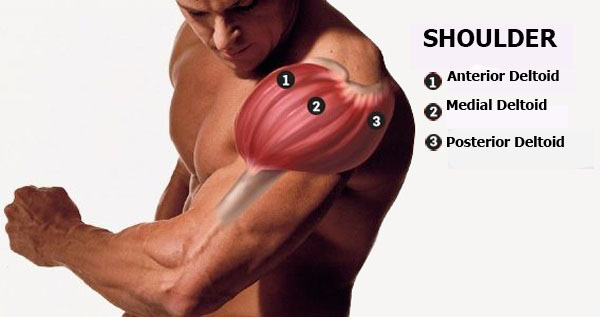
It is vital to understand the interactions of the different muscle groups in the shoulder. The shoulder is built as a ball-and-socket joint which provides incredible range of motion, but very poor stability. The rotator cuff, possibly the most frequently injured portion of the shoulder, is made up of many smaller muscles that can easily become injured if over used, or used improperly. The deltoid of the shoulder is the muscle group that covers the exterior of the joint, and is divided into three separate heads:

Anterior Deltoid: The front head of the shoulder muscle flexes and rotates the arm inward. The anterior delts are important in bench pressing, other chest training, and are usually also stimulated from triceps and biceps exercises. It can be very easy for a traditional bodybuilder to over develop this muscle, leading to a muscular imbalance that can cause injury and posture difficulties.

Medial Deltoid: Is the side head of the shoulder, and acts to abduct the arm, which means it brings the arms out and away from the midline of the body. This muscle activates most during isolated shoulder abduction movements, such as dumbbell side raises. Development of this muscle brings width to the upper torso.

Posterior Deltoid: Extending and rotating the arm outward is the function of the back deltoid. Back exercises such as rows, chin ups, and pull ups work the rear delts more than most other exercises. Isolating the posterior deltoid can be done with reverse flyes.

The Top 5 Exercises for Increasing Shoulder Muscles

Almost every arm exercise works the shoulder muscles to some degree. When you are trying to isolate the shoulders, remember that other exercises may have already put some strain on them, so it is important to balance your workout to include the portions of your shoulders that might not already be worked out. Plan all training carefully, to engage muscle groups evenly.
Top Shoulder Exercise #1 – Seated Barbell Press


Exercise Instructions:

  1. Sit down on a military press bench or adjust an adjustable angle bench, setting the back to 90 degrees.
  2. Load a barbell with the appropriate weight. Ideally, you can un-rack the weight from a weight rack or have a training partner hand you the bar.
  3. Hold the bar with an overhand grip (palms facing forward) with your hands just beyond shoulder width. Your arms will now be almost fully extended above your head with a slight bend in your elbows. This is the starting position.
  4. Slowly begin lowering the bar to your upper chest - almost touching your collarbone.
  5. Pause, and then begin pushing the bar back up to the starting position.
  6. Repeat for desired reps.
Shoulder Press Tips:

  1. Keep your back straight throughout the movement. Don't let it arc too much when pressing the weight.
  2. Use slow and controlled movement, both when pressing and when lowering the weight.
  3. Use a full range of motion by lowering the bar as far as possible, and raising all the way up without locking your elbows out at the top of the movement.
  4. Don't "rest" with the weight on your chest during the set!  
Top Shoulder Exercise #2 – Seated Arnold Press 

Exercise Instructions:

  1. Set up for the exercise by getting an adjustable angle bench and setting the back to 90 degrees.  
  2. Grasp a pair of dumbbells and sit down on the bench with the ends of the dumbbells on your thighs.
  3. Use your thighs to help you raise the dumbbells to shoulder height on each side, and twist so that your palms are facing your body. The dumbbells should now be positioned directly in front of your shoulders.
  4. Your back should be flat against the back rest and your feet firmly planted on the floor for stability. This is the starting position for the exercise.
  5. Keeping your eyes facing forwards, slowly raise the dumbbells above your head while turning your wrists so that your palms are now facing forward (away from your body).  
  6. Keep raising the weight until your arms are almost fully extended.
  7. Do not pause at the top of the movement, and immediately begin lowering the dumbbells back down to the starting position - twisting at the wrists until your palms are facing your body once again.
  8. Repeat for desired reps.
Exercise Tips:
  1. Always use a full range of motion and control the dumbbells throughout the set.
  2. This exercise can be performed while sitting on the end of a flat bench, but a back rest is preferred - especially for those with lower back problems.
Top Shoulder Exercise #3 – Alternate Standing Dumbbell Front Raise


            Exercise Instructions:

  1. Choose a pair of dumbbells and stand up straight with your feet at around shoulder width apart.
  2. Hold the dumbbells with your arms fully extended down by your thighs in front of you body. Use an overhand grip (palms facing your body). This is the starting position.
  3. Begin by raising your left arm straight out in front of you body with your palm facing the floor. Keep a slight bend in your elbow.
  4. Moving only at the shoulder and keeping your body as still as possible, continue raising the dumbbell out in front of you until your arm is just above parallel to the floor.  
  5. Pause for a brief moment at the top of the movement, and slowly lower the dumbbell back to the starting position.
  6. Immediately repeat this movement using your right arm. This is one rep.
  7. Repeat for desired reps.
Exercise Tips:

  1. Practice good form with a light weight.
  2. Focus on moving only at the shoulders. The rest of your body should be kept as still as possible and your arms should hold the same form throughout the movement.
  3. Use slow and controlled movement - avoid "swinging" the weights up and dropping them quickly.
Top Shoulder Exercise #4 – Dumbbell Lateral Raise


Exercise Instructions:

  1. The dumbbell lateral raise is a good exercise for building width in your upper body which gives you the "V" shape. Grab a set of dumbbells and stand straight up with the dumbbells at your sides.
  2. Your palms should be facing your body. You should be holding the dumbbells slightly off your body, as this keeps the tension on the side delts. This is your starting position for the exercise.
  3. To execute, slowly raise the dumbbells up to around shoulder height. It's important that you do not let your wrists go above your elbows while raising the weight, as this will take the work off the side delts and put it on the front delts.
  4. Pause at the top of the movement, and then slowly lower the weight back to the starting position.
  5. Do not let the dumbbells touch your body, and then raise them for the next rep.
​Lateral Raise Tips:

  1. The dumbbell lateral raise is one of those exercises that so many people do incorrectly. First, this is an isolation exercise, so you should be focusing on stretch and muscle contraction, not using heavy weights.
  2. Second, you MUST keep your rep timing slow and controlled. So many people use momentum to swing heavy weights up, and this is not going to get you the best results from the dumbbell lateral raise.
  3. Third, it very important that your elbows stay above your wrists. If your wrists come up too far, the focus comes off your side delts and onto your front delts. A good trick to ensure this does not happen is to tilt the dumbbells down as if you were pouring a jug of water as you raise them up. This makes it very hard to raise the wrists higher than the elbows.
  4. And finally, keep the side delts under stress for the whole set by not allowing the dumbbells to touch your body or "hang" at the bottom of the movement.
Top Shoulder Exercise #5 – Face Pull

Exercise Instructions:

  1. Sit in the same position on a low pulley row station as you would if you were doing seated cable rows for the back.
  2. Attach a rope to the pulley and grasp it with an overhand grip. Your arms should be extended and parallel to the floor with the elbows flared out.
  3. Keep your lower back upright and slide your hips back so that your knees are slightly bent. This will be your starting position.
  4. Pull the cable attachment towards your upper chest, just below the neck, as you keep your elbows up and out to the sides. Continue this motion as you exhale until the elbows travel slightly behind the back.Tip: Keep your upper arms horizontal, perpendicular to the torso and parallel to the floor throughout the motion.
  5. Go back to the initial position where the arms are extended and the shoulders are stretched forward. Inhale as you perform this portion of the movement.
  6. Repeat for the recommended amount of repetitions.
Variations: You can also perform this exercise using exercise bands or dumbbells. You can also perform this movement standing in front of a high pulley.